Introduction
For procurement managers and engineering leads sourcing metal parts for automotive or industrial applications, choosing an uncertified supplier is one of the fastest ways to fail an OEM audit or trigger costly recalls.
When a Tier 1 supplier delivers non-conforming stampings or a die casting batch fails dimensional inspection, the fallout extends beyond scrapped parts. It can mean production line shutdowns, warranty claims, and customer relationships that take years to rebuild.
IATF 16949:2016 certification has become the baseline qualification filter for automotive supply chains because it addresses these risks systematically. This guide covers:
- What IATF 16949:2016 is and how it evolved
- Its core requirements and what auditors actually check
- How it differs from ISO 9001:2015
- A practical framework for evaluating certified metal parts manufacturers before signing a contract
Key Takeaways
- IATF 16949:2016 is the global automotive quality standard, replacing ISO/TS 16949
- It builds on ISO 9001:2015 by adding automotive requirements: defect prevention, PPAP, FMEA, and OEM-specific rules
- BMW, Ford, GM, Volkswagen, and Stellantis all require Tier 1 and Tier 2 suppliers to hold valid certification
- Verify certificate scope, audit results, and CQI assessments alongside the certificate, not in place of reviewing it
What Is IATF 16949:2016? Definition, History, and Core Objectives
IATF 16949:2016 is a quality management system standard issued by the International Automotive Task Force (IATF) on October 1, 2016. It replaced the earlier ISO/TS 16949 standard that had governed automotive quality since 1999. Companies must now be certified to this version—the previous standard is no longer valid.
The IATF is a consortium of 12 major automotive OEMs and 5 national trade associations. That breadth of membership is precisely what gives the standard its global authority — any supplier working across multiple OEM relationships must comply with a single unified framework rather than separate national systems.
| OEM Members | Trade Associations |
|---|---|
| BMW Group, Ford Motor Company, Geely Holding Group | AIAG (U.S.) |
| General Motors, IVECO Group, Jaguar Land Rover | ANFIA (Italy) |
| Mercedes-Benz Group AG, Renault Group, Stellantis (ex FCA) | FIEV (France) |
| Stellantis (ex PSA), Volkswagen AG, Volvo Group | SMMT (U.K.) / VDA (Germany) |
Together, these organizations partnered with ISO to replace the fragmented national and corporate certification systems — such as VDA 6.1 in Germany and QS 9000 in North America — that existed before.
Transition From ISO/TS 16949 to IATF 16949:2016
The key structural change: IATF 16949:2016 adopts the ISO 9001:2015 High Level Structure (Annex SL) as its base and layers automotive-specific requirements on top. Companies cannot be certified to IATF 16949 without first satisfying all ISO 9001:2015 requirements—it is a supplement, not a replacement. The transition deadline from ISO/TS 16949 to the new standard was September 2018.
Major enhancements introduced in 2016 include:
- Stronger customer orientation with explicit OEM customer-specific requirements (CSRs)
- Greater emphasis on risk-based thinking
- Explicit inclusion of automotive core tools: APQP, PPAP, FMEA, MSA, SPC
- Requirements that suppliers cascade quality obligations down through their own sub-supplier chains
The Five Core Objectives of IATF 16949:2016
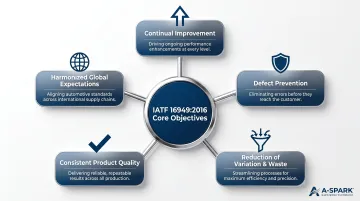
IATF 16949:2016 is built around five core objectives:
- Continual improvement — structured feedback loops drive ongoing process and product gains
- Defect prevention — problems are designed out, not inspected out after the fact
- Reduction of variation and waste across the supply chain
- Consistent product quality that translates directly into customer satisfaction
- Harmonized quality expectations across all geographies and supplier tiers
What IATF 16949:2016 Requires: Key Clauses and Audit Areas
IATF 16949:2016 is organized into 10 clauses. Clauses 1–3 are introductory; Clauses 4–10 contain the auditable requirements. An IATF audit assesses conformance across all applicable clauses, not just manufacturing output.
The auditable clauses cover four core areas that auditors examine in every certification cycle:
- Clause 4 (Organizational Context) — Manufacturers must formally identify internal and external factors affecting quality, define their QMS scope, and document stakeholder needs.
- Clause 9.2 (Internal Audit) — Regular internal audits are required to verify QMS function, catch nonconformities before external review, and close gaps systematically. Sub-clause 9.2.2.1 specifies the audit programme requirements. This is an ongoing process obligation, not a one-time event.
- Clauses 7 & 8 (Resources & Operations) — Covers personnel competence, infrastructure, product and process design controls, sub-supplier management, and production controls.
- Clauses 9 & 10 (Performance & Improvement) — Manufacturers must measure customer satisfaction, conduct management reviews, track process indicators, and run structured corrective action processes.
For metal parts manufacturers, Clauses 7 and 8 carry the most operational weight. Auditors expect documented process controls for casting, machining, surface treatment, and assembly — not just quality records after the fact. A-SPARK Manufacturing's documented controls span die casting (27 in-house presses, 50–800 tons), CNC machining (3-, 4-, and 5-axis milling), and surface treatment lines (powder coating and E-coating), each supported by quality control plans, process FMEA, and capability studies.
Clause 10.2.3 (Problem Solving) draws particular scrutiny. It does not mandate a specific methodology like 8D, but requires a structured approach covering containment, root cause analysis, systemic corrective actions, and effectiveness verification. Problem solving was the number-one nonconformity by frequency in third-party IATF 16949 audits in 2024 — making it a critical evaluation point when qualifying suppliers.
IATF 16949:2016 vs. ISO 9001:2015: What's the Difference?
ISO 9001:2015 is the foundational general-industry quality management standard; IATF 16949:2016 is a sector-specific extension built on top of it. A manufacturer certified to IATF 16949 automatically satisfies ISO 9001:2015 requirements, but the reverse is not true.
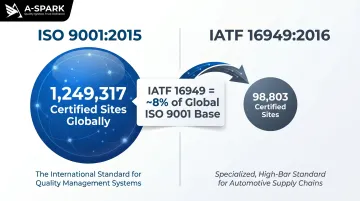
As of January 2025, approximately 98,803 sites worldwide hold IATF 16949 certification, compared to approximately 1,249,317 ISO 9001 certified sites in 2023. IATF 16949 certified sites represent roughly 8% of the global ISO 9001 base, making it a specialized, high-bar standard reserved for automotive supply chains.
Critical Additions IATF 16949:2016 Makes Beyond ISO 9001
Automotive core tools (mandatory use):
- APQP (Advanced Product Quality Planning)
- PPAP (Production Part Approval Process)
- FMEA (Failure Mode and Effects Analysis)
- MSA (Measurement Systems Analysis)
- SPC (Statistical Process Control)
Customer-specific requirements (CSRs) layer OEM-level mandates on top of the base standard. GM's CSRs (effective March 2025) require AIAG PPAP compliance and annual CQI self-assessments for all certified suppliers. Ford extends requirements further down the chain through its published sub-tier supplier quality minimums.
Manufacturing feasibility analysis and embedded product safety requirements go beyond anything ISO 9001 mandates.
Extended supply chain control covers sub-tier suppliers, not just Tier 1 — closing a gap that ISO 9001 leaves open.
Practical Implication for Buyers
A supplier holding only ISO 9001:2015 certification may produce acceptable general-industry components but cannot guarantee the risk controls, traceability, and process discipline that automotive, EV, and aerospace OEMs require. For safety-critical or high-volume metal parts, IATF 16949 certification is the baseline — buyers who skip this check during supplier qualification expose themselves to PPAP failures, CSR non-compliance, and costly re-sourcing mid-program.
Why IATF 16949:2016 Certification Matters When Sourcing Metal Parts
IATF 16949 certification functions as a qualification filter in global supply chains. OEMs use it as a baseline requirement to reduce the risk of onboarding suppliers who cannot sustain consistent part quality at volume. An IBM study estimates that warranty expenses cost automotive OEMs an average of approximately 2% of revenue, amounting to over $50 billion industry-wide.
Specific Quality Protections for Metal Parts Categories
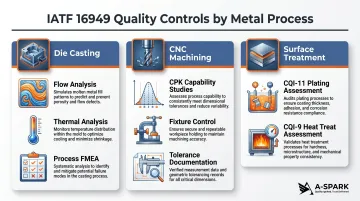
Die castings, stampings, machined components, and surface-treated parts all involve process variables that can introduce defects. The standard's requirements for process control plans, control charts (SPC), and measurement system analysis (MSA) directly constrain variation in metal parts production. For example:
- Die casting: Flow analysis, thermal analysis, and process FMEA identify potential defects before production begins
- CNC machining: CPK capability studies and documented fixture controls ensure tight tolerances across production runs
- Surface treatment: CQI-11 (Plating System Assessment) and CQI-9 (Heat Treat System Assessment) provide special process controls
GM's CSR mandates annual self-assessments using AIAG CQI standards directly relevant to metal parts:
- CQI-9: Heat Treat
- CQI-11: Plating
- CQI-15: Welding
Buyers of die castings, stampings, and surface-treated parts should ask suppliers for current CQI assessment results alongside IATF certificates.
Traceability and Documentation Requirements
IATF 16949 requires manufacturers to maintain full traceability of materials, process records, and inspection results. Buyers can request PPAP documentation packages before approving a new part. The AIAG PPAP manual defines 5 submission levels:
| Level | What Is Submitted | What Is Retained |
|---|---|---|
| 1 | Part Submission Warrant (PSW) only | All 18 elements retained by supplier |
| 2 | PSW with samples and limited data | Remaining elements retained |
| 3 | PSW with samples and complete data (default) | Master samples, checking aids retained |
| 4 | PSW and customer-defined requirements | All other elements per customer |
| 5 | No submission; all retained on-site | All 18 elements available for on-site review |
This protects buyers during recalls or warranty investigations by providing full documentation trails.
Supply Chain Transparency as a Structural Benefit
IATF 16949 requires certified manufacturers to extend quality requirements to their own sub-suppliers. A-SPARK Manufacturing works with a network of IATF 16949-certified manufacturing partners across Vietnam, which means quality requirements carry through to sub-suppliers — not just the primary facility. For buyers, that upstream visibility is a practical safeguard against defects that originate outside the main production site.
Business Case Beyond Automotive
The EV supply chain "will need to implement the automotive quality tools (including IATF 16949 and the AIAG core tools)," according to one industry analysis. That reach extends well beyond traditional automotive. IATF 16949 has become a recognized quality benchmark across:
- Electric vehicles and EV charging infrastructure
- Industrial equipment and renewable energy components
- Electronics enclosures and oil & gas parts
For procurement teams, sourcing from a certified manufacturer cuts pre-qualification audit time, speeds up supplier approvals, and simplifies their own compliance documentation.
How to Choose an IATF 16949-Certified Metal Parts Manufacturer
The certificate alone is not enough. Apply these verification steps:
Verify Certificate Validity and Scope
- Check the IATF Customer Portal using the IATF Certificate number to confirm certificate validity
- Confirm audit scope covers the specific processes required (e.g., die casting, CNC machining, surface treatment, assembly)
- Request the certificate with scope statement—not just a logo on a website
A supplier certified for assembly operations does not automatically hold certification for special processes like heat treatment or plating. A-SPARK's IATF 16949:2016 certification (Certificate Number IATF 0450385, issued by SGS) covers zinc and aluminum die casting, machining, painting, injection molding, and stamping parts production at their Bac Ninh, Vietnam facility.
Apply Three Additional Due Diligence Checkpoints
1. Request a PPAP package or sample quality plan This verifies that quality tools are actively used, not just documented. Look for:
- Process Flow Charts and Control Plans
- Process FMEA and Capability Studies
- Material Certifications
2. Ask about customer-specific requirements (CSR) experience A manufacturer that has worked directly with Tier 1 or OEM customers will have embedded CSR processes. Under the IATF Rules 6th Edition (effective January 1, 2025), certificates follow a 3-year cycle with mandatory surveillance audits — if timing lapses, certification is automatically cancelled. CSR compliance consistency matters.
3. Evaluate supply chain integration A manufacturer that manages sourcing, logistics, and sub-supplier quality directly reduces your oversight burden. Look for on-site engineering support, DFM capability, and documented supplier management processes — not just assembly capacity.
Asia Sourcing Context
For global OEMs sourcing metal parts from Vietnam, China, or broader Southeast Asia, IATF 16949 certification is particularly important because it provides a consistent quality framework regardless of where parts are sourced. Asia-Pacific holds 78.35% of all IATF 16949 certified sites globally, with China alone accounting for approximately 57,041 sites (57.7%).
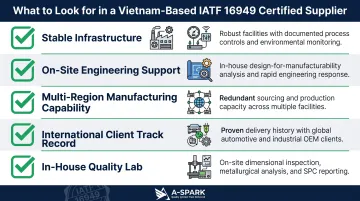
What to look for in a Vietnam-based certified supplier:
- Stable factory infrastructure with documented process controls
- On-site engineering support with DFM analysis capabilities
- Multi-region manufacturing capability for supply chain redundancy
- Track record with international clients across automotive, EV, and industrial sectors
- In-house quality lab with advanced testing equipment (spectrometer, CMM, profile projector)
A-SPARK Manufacturing operates from Bac Ninh, Vietnam, with 27 in-house die casting presses (50–800 tons), 15 sets of multi-axis CNC milling machines, and in-house surface treatment lines — all backed by ISO 9001:2015 and IATF 16949:2016 certifications.
Frequently Asked Questions
What is IATF 16949:2016 certification for metal parts manufacturers?
IATF 16949:2016 is the international quality management standard for automotive supply chains. For metal parts manufacturers, it governs process controls, defect prevention, and traceability requirements for components supplied to OEMs and Tier 1 automotive customers.
Who are the IATF OEMs?
The major OEMs that are members of the IATF include BMW Group, Ford Motor Company, Geely Holding Group, General Motors, IVECO Group, Jaguar Land Rover, Mercedes-Benz Group AG, Renault Group, Stellantis, Volkswagen AG, and Volvo Group. These companies require their supply chain partners to hold valid IATF 16949 certification.
What is the difference between AS9100D and IATF 16949:2016?
AS9100D is the quality management standard for aerospace and defense, while IATF 16949:2016 is specific to automotive. Both build on ISO 9001:2015 but add sector-specific requirements. AS9100D emphasizes flight safety and configuration management, while IATF 16949 focuses on defect prevention, automotive core tools, and OEM customer-specific requirements.
What do clauses 9.2 and 2.2 in IATF 16949:2016 cover?
Clause 9.2 covers internal audit requirements, mandating that certified manufacturers conduct planned, systematic audits to verify QMS effectiveness and identify nonconformities. Note: "Clause 2.2" does not exist in IATF 16949:2016 — Clause 2 covers Normative References only. If you're looking for stakeholder requirements, that's Clause 4.2.
How much does IATF 16949:2016 certification cost?
Certification costs vary depending on company size, number of sites, chosen certification body, and audit duration. Under the IATF Rules 6th Edition (effective January 2025), certification follows a 3-year cycle with surveillance audits at 12-month intervals and recertification every three years. Corporate audit scheme reductions are now capped at 15% of minimum audit days.