Introduction
A single component failure in aerospace, automotive, or medical applications can cascade into costly failures—a grounded brake, a fractured implant, a seized valve. In industries where precision isn't optional, CNC turned parts form the critical infrastructure. These cylindrical components rotate at thousands of RPMs while cutting tools strip away material to tolerances as tight as ±0.005 mm. That micron-level accuracy is what keeps pressure-critical valve stems sealed, aerospace bushings loaded, and surgical implants biocompatible.
Getting that accuracy consistently — from prototype through production — requires understanding how CNC turning works, where it excels, and what separates a capable supplier from a costly mistake.
This guide covers:
- What CNC turned parts are and how they're made (CAD to finished component)
- Material selection across metals and engineering plastics
- Industry-specific applications from automotive to medical devices
- Certifications and capabilities that define a qualified manufacturing partner
Whether you're sourcing precision shafts for EV drivetrains or threaded connectors for hydraulic systems, these fundamentals impact your product's reliability, cost structure, and time to market.
Key Takeaways
- CNC turning produces cylindrical components by rotating bar stock while computer-controlled tools remove material to precise dimensions
- Tolerances range from ±0.13 mm (standard) to ±0.005 mm (precision), with tight repeatability essential for high-volume automotive and aerospace runs
- Common materials: aluminum, stainless steel, brass, titanium, and engineering plastics such as PEEK and Delrin
- Primary applications span automotive drivetrains, aerospace hydraulics, medical implants, industrial valves, and electronics hardware
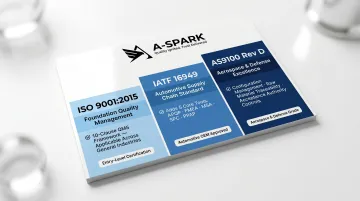
- Qualified partners hold ISO 9001:2015 at minimum; automotive supply chains require IATF 16949 certification
What Are CNC Turned Parts?
CNC turned parts are precision components manufactured by rotating a workpiece—typically bar stock or billet—at high speed on a computer-controlled lathe while a stationary cutting tool removes material. The "CNC" (Computer Numerical Control) designation refers to the G-code program that governs every aspect of the operation: tool path, spindle speed (RPM), feed rate (material removal speed), and depth of cut. This program originates from CAD/CAM software, translating engineering drawings into machine instructions with micron-level precision.
Turning vs. Milling
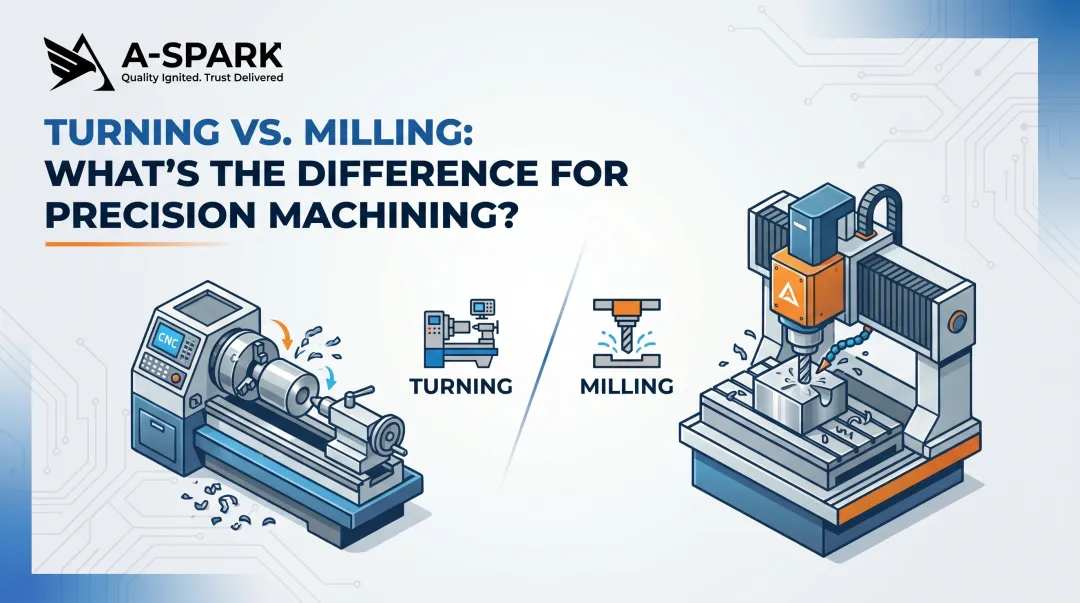
In CNC turning, the workpiece rotates while the tool remains stationary; in CNC milling, the cutting tool rotates while the workpiece stays fixed. This distinction matters in practice: turning is the natural choice for cylindrical or symmetric shapes—shafts, pins, bushings, valve bodies, threaded fasteners.
Milling those same shapes would require complex multi-axis movements and longer cycle times. Turning achieves them in a single setup.
Geometry Types
Shafts, Pins & Spacers (Cylindrical) The most common category includes shafts, pins, spacers, and standoffs—parts with consistent outer diameters along their length. Tolerances range from ±0.025 mm for general industrial use to ±0.005 mm for precision aerospace applications.
Bolts, Studs & Threaded Inserts Specialized threading tools cut precise helical grooves to metric, UNC, or UNF standards. Deviations as small as 0.01 mm can prevent proper mating or create leak paths in hydraulic fittings.
Flanged and Grooved Parts Flanges seat O-rings or mating components; grooves retain snap rings or provide oil channels. Modern multi-axis CNC lathes with live tooling can add milled features—flats, slots, cross-holes—in the same setup, cutting lead time significantly.
Tapered & Complex Profiles Tapered shafts, spherical ends, and compound radii are straightforward for CNC: the programmed tool path follows the exact CAD contour, delivering consistent geometry across thousands of parts.
Common Part Examples
- Fasteners & Connectors: Precision bolts, hex nuts, threaded studs, hydraulic fittings (SAE, NPT), pneumatic quick-connects
- Valve Components: Stems, seats, bodies, actuator pins—thread precision and surface finish directly affect sealing performance
- Bushings & Spacers: Bronze bushings for rotating shafts, aluminum spacers for electronics assemblies
- Medical Implants: Bone screws (titanium), dental abutments, spinal rod connectors—biocompatibility and surface finish are critical
- Electronics Hardware: Contact pins (brass, phosphor bronze), standoffs, threaded inserts for PCB mounting
How CNC Turned Parts Are Manufactured
Step 1: Design & Programming
Manufacturing begins with a CAD model (the engineering drawing translated into 3D geometry). CAM software processes this model to generate G-code, the numerical language controlling the CNC lathe. This stage determines both cost and quality: specifying ISO 2768-m general tolerances instead of unnecessarily tight ±0.01 mm reduces machining time and inspection overhead.
DFM (Design for Manufacturability) reviews catch problems before the first cut. Common issues flagged at this stage include:
- Non-standard thread pitches that require custom tooling
- Sharp internal corners that stress cutting inserts prematurely
- Surface finish specifications tighter than functional requirements demand
Step 2: Material Selection & Setup
Bar stock or billet is secured in the chuck (for larger diameters) or collet (for precision work requiring minimal runout). Tool offset values then calibrate each insert's position relative to the workpiece centerline, establishing the dimensional baseline before cutting begins.
Tool selection depends on material:
- Steel: Carbide inserts with coatings for heat resistance
- Aluminum: Polycrystalline diamond (PCD) for edge retention and surface quality
- Threading/grooving: Specialized insert geometries matched to the profile
Step 3: Machining Operations
Rough Turning
Doubling the depth of cut doubles productivity with no increase in cutting temperature or force, making rough turning the most efficient metal removal phase. Typical depths range from 2-5 mm depending on material hardness and machine rigidity.
Finish Turning
Feed rates slow to 0.05-0.15 mm/rev to achieve specified surface finish and dimensional accuracy. Carbide inserts should be indexed at 0.38 mm (0.015 in) flank wear to maintain quality; worn tools leave visible chatter marks and dimensional drift.
Boring
Internal diameters are machined by inserting a boring bar through the rotating workpiece. Steel bars limit overhang to 4:1 length-to-diameter ratio; tungsten carbide extends this to 6:1 for deeper holes.
Threading
Specialized inserts with 60-degree included angles cut threads in a single or multiple passes. Thread depth, pitch, and class (tolerance grade) must match the mating component exactly. For example, a Class 2A external thread requires a Class 2B internal thread for proper fit.
Grooving and Parting
Narrow tools cut grooves for O-ring retention or snap rings; parting tools separate the finished component from bar stock. Both operations generate high cutting forces in a small area, requiring a rigid workholding setup to prevent tool deflection.
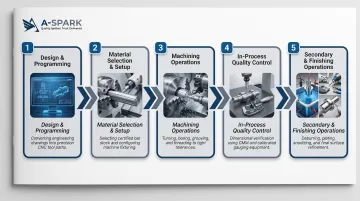
Step 4: In-Process Quality Control
High-volume manufacturers generate millions of SPC data points annually using HAAS CNC probes and CMMs, tracking control charts and calculating Cpk (process capability index). Key benchmarks:
| Parameter | Standard Production | Aerospace / Medical |
|---|---|---|
| Cpk target | ≥ 1.33 | ≥ 1.67 |
| Inspection interval | Every 50 parts | Every 10 parts |
| Gauging method | Micrometers, bore gauges | CMM + SPC charting |
Step 5: Secondary & Finishing Operations
Surface treatments and finishing operations extend part life and meet environmental or assembly requirements. Each process is selected based on material and end-use conditions:
- Deburring: Removes sharp edges from parting and drilling operations
- Anodizing (aluminum): Creates corrosion-resistant oxide layer; Type II sulfuric anodizing adds 0.0127-0.0254 mm per surface
- Passivation (stainless steel): Chemical treatment removes free iron, enhancing natural corrosion resistance
- Black oxide (steel): Provides mild corrosion protection and reduces light reflection
- Heat treatment: Hardening and tempering increase surface hardness (HRC 50-60 typical for wear resistance)
Materials Used in CNC Turning
Metals: Machinability Ratings
Machinability ratings relative to AISI 1112 carbon steel (100% baseline) show dramatic variation:
| Material | Machinability Rating | Typical Applications |
|---|---|---|
| Free-cutting brass (C36000) | 300% | Plumbing fittings, electrical connectors |
| Aluminum 2011 | 190% | High-speed production, electronics hardware |
| Stainless 303 (annealed) | 78% | Food processing, medical instruments |
| Stainless 304 (annealed) | 45% | Corrosion-critical environments |
| Stainless 316 (annealed) | 45% | Marine, chemical processing |
| Titanium Grade 2 | 22% | Aerospace, medical implants |
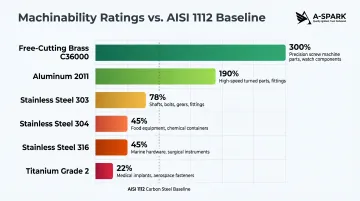
Titanium parts cost 4-5x aluminum at equivalent geometry due to slower cutting speeds, rapid tool wear, and higher raw material cost. Switching from 304 to 303 stainless steel can reduce total part cost 20-30% through improved machinability alone.
Aluminum Alloys
| Alloy | Tensile Strength | Best For |
|---|---|---|
| 6061-T6 | 310 MPa | Automotive brackets, electronics housings, industrial components |
| 7075-T6 | 570 MPa | Aerospace fittings, high-stress parts where weight savings justify the premium |
7075-T6 trades corrosion resistance for strength. For most structural applications, 6061-T6 is the more cost-effective starting point.
Steel and Stainless Steel
| Grade | Key Property | Common Applications |
|---|---|---|
| 1018 Carbon Steel | Low cost, easy machining | Non-critical shafts, pins in dry environments |
| 4140 Alloy Steel | HRC 50-60 after heat treatment | Gears, shafts, tooling components |
| 303 Stainless | 78% machinability rating | Turned stainless parts requiring corrosion resistance |
| 316 Stainless | Superior corrosion resistance | Marine, chemical processing environments |
The jump from 303 to 316 stainless delivers meaningfully better corrosion resistance in aggressive environments — but the 45% machinability rating translates directly into longer cycle times and higher part cost.
Brass and Bronze
C36000 (Free-Cutting Brass) leads all metals at 300% machinability — ideal for high-volume threaded fittings, valve stems, and electrical connectors. It holds up well against water and mild chemicals.
Phosphor Bronze (C510) offers higher strength than brass, making it the standard choice for bearings, bushings, and spring contacts where wear resistance and electrical conductivity both matter.
Titanium
Grade 2 (Commercially Pure): Biocompatible, corrosion-proof, 22% machinability rating. Used for medical implants (bone screws, dental abutments) and aerospace fasteners where strength-to-weight ratio justifies the cost.
Grade 5 (Ti-6Al-4V): The most widely specified aerospace titanium alloy, offering higher strength than Grade 2 with the same machining difficulty. Both grades require carbide tooling, slow surface speeds (30-50 m/min vs. 200+ m/min for aluminum), and flood coolant throughout.
Engineering Plastics
PEEK (Polyetheretherketone):
Stronger and stiffer than most plastics but softer than metals, PEEK demands specialized machining. Use C-2 carbide or PCD inserts with positive rake angles; 360-degree chuck pressure prevents distortion.
Applications include semiconductor handling, medical devices, and high-temperature bearings. Note that all PEEK grades are more abrasive on tooling than nylon or acetal — particularly glass and carbon fiber reinforced versions.
Delrin (Acetal):
Excellent dimensional stability, low moisture absorption, high machinability. Used for gears, bushings, and precision mechanical parts where metal weight is unacceptable.
PTFE (Teflon):
Lowest friction coefficient of any solid material and fully chemically inert. PTFE is extremely soft, requiring sharp tools, high feed rates, and minimal cutting forces to prevent deformation.
Key Applications Across Industries
Automotive & EV
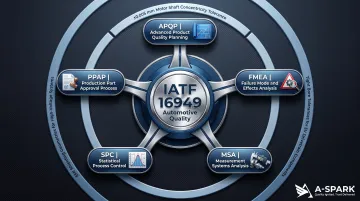
The precision turned product manufacturing market reached USD 115.39 billion in 2025, with automotive as the dominant segment. High-volume production demands IATF 16949 compliance—covering five core quality disciplines:
- APQP (Advanced Product Quality Planning)
- FMEA (Failure Mode and Effects Analysis)
- MSA (Measurement Systems Analysis)
- SPC (Statistical Process Control)
- PPAP (Production Part Approval Process)
Electric vehicle drivetrains add new turning requirements: motor shafts need ±0.005 mm concentricity, thermal management components (coolant fittings, heat exchanger tubes) demand tight bore tolerances, and sensor housings require EMI shielding geometries.
Aerospace & Defense
Bushings, spacers, hydraulic fittings, and structural connectors made from titanium and high-strength aluminum must meet AS9100 Rev D traceability requirements—extending back to raw material Certificates of Conformance (CoC) and Mill Test Reports (MTR). Configuration management ensures that the physical part matches the approved design exactly; any deviation requires formal engineering change approval.
Medical Devices
Orthopedic bone screws, dental implant abutments, and surgical instrument components combine biocompatibility requirements (ISO 10993 testing for cytotoxicity, sensitization, and implantation effects) with micro-tolerance demands—often ±0.01 mm or tighter. Surface finish drives osseointegration outcomes: Ra 0.8 µm or better promotes bone growth while minimizing bacterial adhesion. ISO 13485 quality management systems add risk management (ISO 14971) and design control requirements beyond ISO 9001 baseline.
Industrial Equipment, Oil & Gas, and Plumbing
Valve stems, hydraulic fittings, pump shafts, and pipe connectors each carry specific material and performance requirements:
- Corrosion resistance: 316 stainless for saltwater exposure; brass for potable water systems
- Pressure validation: burst testing to confirm rated working pressures
- Thread precision: NPT tapers require an exact 1.7899° included angle to seal reliably
- Wear resistance: high-cycle applications (millions of open/close cycles) need hardened surfaces at HRC 50+
Electronics & Renewable Energy
Contact pins (phosphor bronze, beryllium copper), standoffs (aluminum, stainless), precision spacers, and threaded inserts for PCB mounting. Renewable energy applications—wind turbine pitch control hardware, solar tracker pivot pins—prioritize volume efficiency and cost over absolute precision, though corrosion resistance is non-negotiable for 25-year outdoor service life.
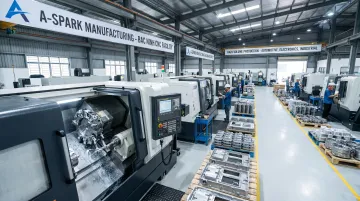
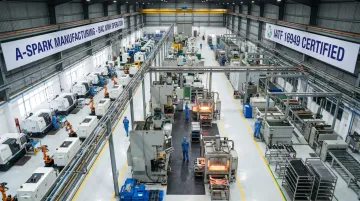
A-SPARK Manufacturing's Bac Ninh facility runs 30 CNC turning machines with up to 50mm diameter capability, covering automotive/EV, electronics, and industrial equipment production. The facility pairs CNC machining with in-house die casting and surface treatment under one IATF 16949-certified roof, giving global OEMs a single source from prototype through mass production.
Advantages of CNC Turned Parts in Precision Manufacturing
Tight Tolerances and Repeatability
Standard CNC machining delivers ±0.005 in (±0.13 mm) tolerance; precision operations achieve ±0.001 in (±0.025 mm); hard turning with ceramic inserts reaches ±0.0002 in (±0.005 mm) on hardened steel. Programmed automation eliminates operator-to-operator variation—part 1 and part 10,000 measure identically.
In assemblies with thousands of components, dimensional stack-ups (cumulative tolerance errors) demand this consistency — a single drift at part 5,000 ripples across the entire build.
Reduced Waste and Cost Efficiency
High first-pass accuracy minimizes scrap. Tight process control reduces rework from 5–10% (typical for manual operations) to under 1% for CNC — a measurable impact on per-part cost.
Unattended operation, lights-out machining with bar feeders and automated part ejection, spreads fixed costs across more parts. As volumes scale from 1,000 to 100,000+, cost-per-piece drops accordingly.
Design Flexibility and Scalability
The same CNC program runs prototype quantities (10–50 parts) and full production (50,000+ parts) with identical quality — no retooling, no re-qualification between phases.
Multi-axis lathes with live tooling add milled features in a single setup:
- Flats and wrench flats — no secondary milling operation needed
- Slots and keyways — cut in-cycle without re-fixturing
- Cross-holes and radial features — drilled at any angle during the turning pass
This single-setup approach eliminates the transfer-and-re-zero cycle that normally adds days to a job, compressing lead times from weeks to days.
What to Look for in a CNC Turned Parts Manufacturer
Certifications and Quality Systems
ISO 9001:2015 establishes documented quality management—defined processes for design control, supplier management, nonconformance handling, and continual improvement. The standard contains 10 clauses; only sections 4-10 are auditable. Critical elements: context of the organization (clause 4), leadership (5), planning (6), support (7), operation (8), performance evaluation (9), improvement (10).
IATF 16949 adds five core tools mandatory for automotive supply chains:
- APQP — structured product quality planning
- FMEA — identify potential failure modes before production
- MSA — analyze measurement system variation
- SPC — monitor processes via statistical control charts
- PPAP — evidence that the process produces conforming product consistently
Without IATF 16949, access to Tier 1 automotive suppliers is effectively blocked.
AS9100 Rev D extends ISO 9001 with aerospace-specific requirements: configuration management (verifying physical parts match approved designs), traceability to raw material CoC and MTR, and acceptance authority controls (stamps, electronic signatures validating inspection results).
Engineering-Driven Support and DFM Capability
A qualified partner reviews designs before quoting, catching cost drivers early: non-standard tolerances (±0.01 mm specified where ±0.05 mm would function identically), sharp internal corners requiring fragile tooling, or surface finish requirements (Ra 0.4 µm) tighter than needed (Ra 1.6 µm adequate). Proven DFM cost-reduction parameters include:
- Maintain 4:1 length-to-diameter ratios to avoid deflection and chatter
- Use minimum 0.008 in corner radii to reduce tool breakage risk
- Account for ±10% bar stock diameter variation in tolerance stack-ups
Integrated Capabilities and Supply Chain Stability
Vertically integrated manufacturers reduce handoffs, cut third-party markups, and compress design-to-production timelines by keeping machining, casting, finishing, and assembly under one roof.
A-SPARK Manufacturing's Bac Ninh facility covers CNC turning (30 machines, up to 50mm diameter), aluminum/zinc die casting with in-house tooling, anodizing, powder coating, and assembly operations. That consolidation matters for IATF 16949 and AS9100 compliance: documentation chains must remain unbroken from raw material receipt through final inspection, and every handoff to a third party introduces a traceability gap.
Frequently Asked Questions
How are CNC turned parts manufactured?
CAD/CAM software converts the part drawing into a G-code program, which drives the CNC lathe through sequential operations: rough turning, finish turning, boring, threading, grooving, and parting off. In-process inspection with micrometers and CMMs validates dimensions at defined intervals throughout the run.
How much does it cost to get a CNC turned part machined?
Key cost drivers are material (titanium runs 4–5× aluminum), tolerance class, complexity, volume, and secondary finishes such as anodizing or plating. Early DFM review—applying standard tolerances where functionally acceptable and avoiding non-standard threads—can cut costs 20–30% without affecting performance.
What are the parts of a CNC turning machine?
Core components are the spindle (500–5,000+ RPM), chuck or collet (workpiece clamping), turret (holds 8–12 tools for automatic changes), X/Z-axis slides (0.001 mm positioning resolution), and CNC controller (executes G-code to manage motion, speed, and coolant). The rigid bed underpins all of these, damping vibration during cuts.
What materials are best for CNC turned parts?
Common choices include aluminum (6061, 7075) for machinability, stainless steel (303, 316) for corrosion resistance, brass (C36000) for high-speed connector production, titanium (Grade 5) for medical and aerospace strength-to-weight, and PEEK or Delrin for dimensionally stable plastic parts. The right selection balances tensile strength, machinability, corrosion resistance, and cost against your application's functional requirements.
What industries rely most on CNC turned parts?
Automotive, aerospace, medical, electronics, industrial equipment, oil & gas, and plumbing all depend heavily on CNC turned parts. These sectors share a common need for cylindrical, threaded, or rotationally symmetric components where dimensional consistency and material traceability are critical requirements.
What tolerances can CNC turned parts achieve?
Standard CNC turning delivers ±0.025 mm to ±0.05 mm tolerances suitable for general industrial applications. Precision setups with calibrated tooling, temperature-controlled environments, and frequent in-process inspection achieve ±0.005 mm to ±0.01 mm. Hard turning with ceramic inserts on hardened steel reaches ±0.005 mm for critical aerospace and medical components. Tighter tolerances require advanced equipment, more frequent inspection, and longer cycle times—directly impacting cost.