Introduction
Plastic injection molding sits at the center of a major automotive manufacturing shift. From dashboard assemblies to EV battery housings, the process now produces components at volumes, speeds, and tolerances that metal fabrication cannot replicate — and as electric vehicles move into mainstream production, demand is accelerating fast.
The global automotive plastics market is projected to grow from $44.2 billion in 2025 to $76.6 billion by 2032 — a CAGR of 7.8%, according to Allied Market Research. Two forces are driving this: aggressive lightweighting mandates tied to fuel efficiency standards, and the EV transition, where every pound shed extends battery range.
Injection molding gives automakers the ability to produce bumpers, interior trim panels, under-hood components, and structural brackets with tight tolerances and consistent repeatability. Modern vehicles contain 411 pounds of plastic on average — a 16% increase from 2012, per the American Chemistry Council. Plastics account for less than 10% of vehicle weight but roughly 50% of volume.
That weight efficiency has a direct performance payoff. A 10% reduction in vehicle weight delivers a 6-8% fuel economy improvement, according to the U.S. Department of Energy — a compelling reason for OEMs to replace metal with engineered plastics wherever structural requirements allow.
This article profiles the leading automotive plastic injection molding companies in 2026, evaluated on IATF 16949 certification, production scale, tooling capabilities, and established OEM partnerships.
Key Takeaways
- Automotive plastic injection molding produces high-volume interior and exterior vehicle components with precision and consistency
- Top suppliers combine IATF 16949 certification, multi-material molding capabilities, and proven OEM relationships
- Prioritize suppliers with in-house tooling, documented PPAP capability, and short-run prototyping before committing to full production
- Companies profiled supply Tier 1 and OEM programs across North America, Europe, and Asia
- Programs needing plastic molding plus die casting or assembly benefit most from IATF-certified, vertically integrated partners in Asia
What Is Automotive Plastic Injection Molding and Why Does It Matter?
Automotive plastic injection molding is a manufacturing process where molten plastic is injected under high pressure into precision molds to produce vehicle components.
These parts appear throughout the vehicle — interior trim (dashboards, door panels, center consoles), exterior body panels (bumpers, grilles, mirror housings), under-hood components (fluid reservoirs, air intake housings), and EV-specific parts like battery enclosure components and charging port housings.
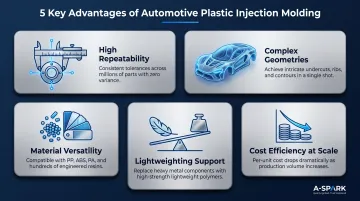
Injection molding holds its position in automotive manufacturing because it delivers what other processes can't match at volume:
- High repeatability: Produces thousands of identical parts with consistent dimensional accuracy
- Complex geometries: Creates intricate shapes impossible or cost-prohibitive with metal stamping
- Material versatility: Works with engineering-grade resins including ABS, polypropylene (PP), polycarbonate (PC), nylon (PA), and high-performance materials like PEEK
- Cost efficiency at scale: Unit costs drop dramatically at production volumes typical of automotive programs
- Lightweighting support: Directly addresses fuel efficiency and EV range goals by replacing heavier metal components
Plastic parts also absorb 4x more crush energy than comparable steel components when using high-performance engineering resins, according to the American Chemistry Council, improving safety performance.
The companies profiled below were evaluated against five criteria:
- IATF 16949 or equivalent automotive certification
- Demonstrated automotive-specific manufacturing experience
- Production scale and machine capacity
- In-house tooling capabilities
- Verified track records with OEM clients
Top Automotive Plastic Injection Molding Companies in 2026
These companies were evaluated on IATF 16949 or equivalent certification status, automotive-specific experience and OEM references, production scale and machine tonnage range, tooling and design-for-manufacturing (DFM) support capabilities, and quality control infrastructure including CMM inspection and mold validation processes.
Magna LexaMar Corp. (a Subsidiary of Magna International)
Magna LexaMar operates as a globally recognized Tier 1 automotive injection molding supplier with facilities across 29 countries, specializing in exterior body plastic components, seating systems, and power & vision systems for major automakers worldwide.
What distinguishes Magna LexaMar from regional competitors is its unmatched global manufacturing footprint and direct OEM partnerships at the highest tier. The company holds IATF 16949, ISO 14001 (environmental management), and ISO 45001 (occupational health and safety) certifications across its operations.
With 344+ manufacturing facilities globally, Magna can support automotive programs requiring regional production, supply chain redundancy, and synchronized global launches.
| Certifications | IATF 16949, ISO 9001, ISO 14001, ISO 45001, ISO/IEC 17025 |
|---|---|
| Core Specialization | Automotive exterior plastic parts, seating systems, complete vehicle systems |
| Geographic Reach | 29 countries, 344+ manufacturing facilities globally |
Wabash Plastics, Inc.
Wabash Plastics is a US-based custom injection molding manufacturer founded in 1973, bringing over 50 years of experience serving automotive OEMs across North America. The company specializes in high-volume, long-run injection molded components and assemblies, positioning itself as a reliable domestic partner for North American automotive supply chains.
The company runs 58+ injection molding machines from 90-ton to 1,300-ton press capacity. Advanced capabilities include:
- 2K/multi-shot molding — multiple materials or colors in a single cycle
- Gas-assist molding — hollow parts with improved structural rigidity
- Insert molding — overmolding plastic around metal inserts
Wabash works with both engineering-grade and commodity resins, making it a strong fit for complex, high-volume programs with diverse material specifications.
| Certifications | ISO 9001:2015 |
|---|---|
| Core Specialization | High-volume custom automotive molding, 2K/multi-shot molding, insert molding |
| Production Capacity | 58+ injection molding machines, 90T to 1,300T press range |
Note: Wabash Plastics holds ISO 9001:2015 but not IATF 16949, which may be a consideration for OEMs with strict supplier certification requirements.
MRC Manufacturing
MRC Manufacturing started in 1976 as Moon Roof Corporation of America, originally producing reaction injection molded T-Top assemblies before evolving into full-scale thermoplastic injection molding for automotive exteriors. Today, the Michigan-based company serves Ford, General Motors, and Chrysler with verified supplier awards from each, specializing in mid-to-large part production, multi-shot molding, and RIM/RRIM.
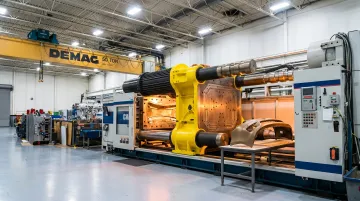
Press capacity up to 4,000 tons enables production of large exterior applications including bumpers, spoilers, rockers, and wheel flares. MRC also provides design support, tooling development, mold repair, in-house priming, and just-in-time logistics — reducing part counts and assembly complexity for OEMs.
| Certifications | ISO 9001:2015, Q1, TS |
|---|---|
| Core Specialization | Large-part injection molding, RIM/RRIM, multi-shot molding, automotive exteriors |
| Notable OEM Clients | Ford, General Motors, Chrysler |
MRC earned Ford Q1 status in 2011 and received GM Supplier of the Year recognition annually from 2009 to 2018, demonstrating sustained quality performance.
Sungplastic
Sungplastic is a Dongguan, China-based manufacturer with over 20 years of experience in plastic injection molding and rapid prototyping. The company serves automotive, electronics, medical, and consumer goods industries with engineering-grade and modified plastic components.
Sungplastic offers rapid prototyping within 3 days using 3D printing and CNC machining, allowing automotive engineers to validate designs before committing to production tooling. The company also provides precision overmolding and insert molding for complex parts — a practical option for OEMs and Tier 1 suppliers looking to source development work from Asia at lower tooling cost.
| Certifications | ISO 9001:2015 |
|---|---|
| Core Specialization | Rapid prototyping, custom injection molding, overmolding, insert molding, engineering-grade plastics |
| Location | Dongguan, Guangdong, China |
Note: IATF 16949 certification claims could not be verified from primary company sources and should be confirmed directly before supplier qualification.
MANAR Inc.
MANAR Inc. is a full-service custom plastic injection molding company headquartered in Indiana, founded in 1974. The company operates four plants across Indiana and Tennessee, serving automotive, aerospace, electronics, and medical sectors with high-complexity molded components and assemblies.
What distinguishes MANAR is its breadth of in-house capability: engineering-grade and specialty resin expertise, tooling, prototyping, and secondary operations including ultrasonic welding and MIG welding — all under one roof. The company delivers DFM support, production, finishing, painting, and sub-assembly as a single turnkey package.
MANAR holds IATF 16949 certification at three of its four plants (GTR Enterprises, Key Manufacturing, and Tennplasco), making it one of the stronger mid-market options for OEMs with strict supplier certification requirements. The company also holds ISO 13485 at two facilities for medical device manufacturing.
| Certifications | IATF 16949, ISO 9001, ISO 13485 |
|---|---|
| Core Specialization | Custom automotive molding, engineering-grade resins, turnkey assembly, under-hood components, interior trim |
| Facilities | 4 plants across Indiana and Tennessee, USA |
MANAR employs approximately 300 people operating 47 presses across its four facilities, according to a February 2026 Plastics News report.
How We Chose the Best Automotive Plastic Injection Molding Companies
Many buyers make critical mistakes when selecting injection molding suppliers: choosing based on price alone without verifying certification validity, overlooking whether the supplier has experience with their specific part geometry or material requirements, or failing to assess production capacity and multi-region sourcing options.
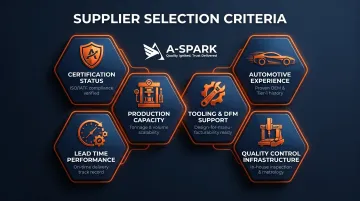
Our evaluation used these primary criteria:
Certification status: IATF 16949 is the automotive gold standard, layering PPAP, FMEA, SPC, and mandatory supplier audits on top of ISO 9001. According to NSF, it also mandates product safety documentation and three types of internal audits. ISO 9001 alone lacks these controls.
Automotive-specific experience: Verified OEM or Tier 1 supplier references demonstrate proven capability in automotive programs requiring stringent quality standards, dimensional tolerances, and documentation.
Production capacity and machine tonnage: Press size range determines which part geometries and sizes a supplier can handle. Automotive programs often require flexibility from prototype (low-tonnage aluminum tooling) through high-volume production (multi-cavity hardened steel molds in high-tonnage presses).
Tooling and DFM support: In-house tooling capabilities reduce lead times and improve communication during mold development. Design-for-manufacturing analysis early in the program prevents costly tooling revisions.
Lead time performance: On-time delivery directly impacts automotive assembly line operations where downtime costs thousands of dollars per minute.
Quality control infrastructure: Coordinate measuring machines (CMM), in-process inspection, and mold validation protocols ensure dimensional accuracy and defect prevention.
Beyond individual supplier criteria, geographic diversification has become a deciding factor for global OEMs and Tier 1 buyers. According to Kaysun's 2026 injection molding trends report, OEMs are actively pursuing regional manufacturing to minimize tariff exposure and reduce supply chain risk. Evaluate whether suppliers maintain capacity across multiple production regions or operate within established industrial zones — both reduce exposure when disruptions hit a single location.
Conclusion
Choosing the right automotive plastic injection molding partner extends beyond checking certification boxes. Buyers must evaluate whether a supplier can scale with their program, respond quickly to engineering changes, and maintain consistent quality across production runs spanning months or years.
Many automotive programs require both plastic injection molded parts and precision metal components—brackets, housings, structural parts—to complete a functional assembly. Managing multiple specialized suppliers across Asia introduces complexity, communication delays, and quality coordination challenges. An IATF 16949-certified partner like A-SPARK Manufacturing can consolidate that coordination under a single accountable source.
A-SPARK operates from Vietnam with over 20 years of die casting and assembly partnership experience. The company holds IATF 16949:2016 certification covering die casting, machining, painting, injection molding, and stamping operations across its partner facility network.
For automotive OEMs and Tier 1 suppliers already sourcing plastic injection molded components from Asia, A-SPARK supplies complementary metal components and performs sub-assembly integration—combining plastic molded parts with die cast housings, machined brackets, and fastening hardware into production-ready assemblies delivered to your specification.
This integrated approach delivers measurable operational benefits:
- Reduces active supplier count across your Asia supply chain
- Consolidates quality documentation under one IATF 16949-certified partner
- Shortens total lead times by eliminating vendor-to-vendor handoffs
- Simplifies logistics coordination with a single point of contact
Ready to discuss how die casting and assembly capabilities can complement your plastic injection molding supply chain in Asia? Contact A-SPARK Manufacturing at sales@a-sparkvn.com or +8435 468 5699 to explore how their Vietnam-based operations can support your automotive program with precision metal components, sub-assembly integration, and multi-tier supply chain coordination.
Frequently Asked Questions
How much does a custom automotive plastic injection mold cost?
According to Formlabs, single-cavity aluminum prototype tooling runs $2,000–$5,000, while hardened steel production tooling costs $5,000–$100,000+ depending on part complexity, cavities, and tolerances. Multi-cavity automotive molds for high-volume programs can exceed $150,000, though per-part costs drop sharply at scale.
What is low-volume injection molding?
Low-volume injection molding covers production runs under 500 parts, used for prototyping, bridge tooling, or niche model variants. These programs use aluminum tooling to reduce upfront costs while maintaining dimensional accuracy, according to Formlabs.
What is the best plastic for injection molding automotive parts?
Material selection depends on the operating environment and mechanical requirements. ABS suits interior trim (impact resistance, surface finish); PP dominates bumpers and under-hood parts (heat tolerance, low cost); PC handles lenses and transparent parts (optical clarity); PEEK or nylon serve high-temperature structural applications like engine and transmission components.
What is the cheapest plastic to injection mold?
Polypropylene (PP) and polyethylene (PE) are among the most cost-effective plastics for injection molding, with PP typically priced around $0.90/lb according to Rex Plastics. Both offer low raw material cost, ease of processing, and wide availability. However, they may not meet performance requirements for all automotive applications, particularly those requiring high-temperature resistance or structural strength under load.
What certifications should I look for in an automotive plastic injection molding supplier?
IATF 16949 is the gold standard for automotive suppliers, adding PPAP, FMEA, MSA, and SPC controls on top of ISO 9001:2015. Also verify ISO 14001 for environmental compliance, and confirm that each certification is current and explicitly covers the processes and part types you're sourcing.
What automotive parts are commonly made using plastic injection molding?
Common applications include interior components (dashboards, door panels, center consoles, trim), exterior parts (bumpers, grilles, mirror housings, fender liners), under-hood components (fluid reservoirs, air intake housings, battery trays), and EV-specific parts (battery enclosure components, charging port housings, cable management brackets). Modern vehicles contain over 2,000 plastic parts on average, according to PlasticsEurope.