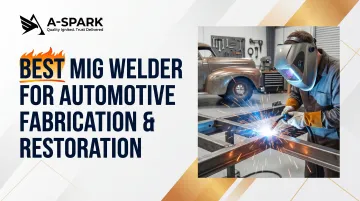
The automotive welding market is crowded with hundreds of options across every price point. Most hobbyist restorers don't need $3,000 pulse-MIG technology, but they do need machines that can dial down to 25–30 amps for clean welds on thin steel. Professional fabrication shops, on the other hand, require dual-voltage machines with bulletproof duty cycles and service networks that can keep them running for a decade or more.
This guide cuts through the noise. You'll learn why MIG is the top choice for automotive work, what specs actually matter (and which are marketing fluff), and the five best machines currently available—from entry-level garage units to professional-grade workhorses used in collision repair centers and motorsports builds.
Key Takeaways
- MIG welding is the go-to for automotive work — easy to learn, precise on thin sheet metal, and strong enough for structural repairs
- Target 110V–240V dual-input machines with 30–200A output and auto-set or synergic wire speed control for consistent body panel results
- Key buying criteria: minimum amperage output, duty cycle at working amps, and dual-voltage flexibility
- Hobbyists: the Hobart Handler 140 delivers strong value; professionals should step up to the Miller Millermatic 211 PRO
Why MIG Welding is the Best Choice for Automotive Work
MIG (Metal Inert Gas) welding—technically GMAW (Gas Metal Arc Welding)—is a wire-feed process that uses a continuous solid wire electrode and a shielding gas (typically 75% Argon / 25% CO2) to protect the weld pool from atmospheric contamination. The result is a clean, strong weld with minimal spatter compared to stick or flux-core processes.
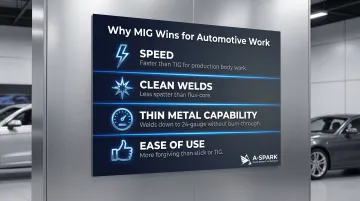
For automotive applications, MIG outperforms alternatives in nearly every metric:
- Deposits metal faster than TIG, making it practical for production body work and collision repair where time directly impacts profitability
- Produces far less spatter and slag than flux-core, which cuts post-weld grinding and finishing work that can damage thin panels
- Welds steel as thin as 24-gauge without burn-through when properly dialed in — a critical capability for body panel repair
- More forgiving for hobbyists and new technicians than stick or TIG, thanks to the continuous wire feed and stable arc
When NOT to Use MIG
MIG isn't always the right answer. Two situations where other processes win:
- Exotic or precision metals: TIG is the better call for titanium or high-grade chromoly used in sanctioned motorsports. TIG offers tighter arc control and cleaner heat input, though it's slower.
- Outdoor or contaminated metal: Self-shielded flux-core handles wind and surface rust better than gas-shielded MIG. The tradeoff is more spatter and cleanup work on finished panels.
Key Specs That Matter When Choosing a MIG Welder for Automotive
Not all MIG welders are created equal, and spec sheets can be deliberately misleading. Here's what actually matters for automotive fabrication and restoration work.
Amperage Range: Minimum Matters as Much as Maximum
Automotive body panels typically range from 18–24 gauge, with exterior panels commonly in the 20–22 gauge range and inner brackets at 24 gauge. Welding this thin material without burn-through requires a machine that can operate at 25–35 amps.
What to look for:
- Minimum amperage: 25–30A for thin body panel work
- Maximum amperage: 130–200A for structural components (subframes, roll cages, chassis reinforcement)
A machine rated "50–140A" may burn through 18-gauge panels because it can't dial down far enough. A 25–140A machine, by contrast, handles everything from delicate patch panels to 1/4" structural steel.
Duty Cycle: Understand Real-World Performance
Duty cycle is the percentage of a 10-minute period a welder can operate at a given amperage before requiring a cooling break. A machine rated "20% duty cycle at 90A" can weld for 2 minutes out of every 10 at 90 amps.
Body panel work involves short tack welds and spot welds rather than continuous beads. A 20–30% duty cycle at 90A is generally adequate for restoration hobbyists, while professional shops handling continuous production should target 40–60%.
One common mistake: buyers focus on maximum-output duty cycle (e.g., "60% at 140A") but ignore duty cycle at typical working amperage (70–90A for body panels). Always check duty cycle ratings at the amperage you'll actually use.
Input Voltage: 110V vs 220V vs Dual-Voltage
110V (120V) machines:
- Run on standard household circuits (typically 20-amp breakers)
- Adequate for most sheet metal work and light structural fabrication
- Maximum thickness capability limited to 1/4"–3/8" depending on model
220V (240V) machines:
- Require dedicated circuits (common in professional shops)
- Handle heavier structural fabrication and thicker materials
- Higher duty cycles and better performance at upper amperage ranges
Dual-voltage machines:
- Offer maximum flexibility for garage-to-shop transitions
- Allow you to use the same welder at home (120V) and in a professional setting (240V)
- Typically include an MVP plug or switch to accommodate both voltages
If you're starting in a home garage and might expand to a dedicated shop, dual-voltage machines like the Miller Millermatic 211 PRO let you avoid buying a second machine when you upgrade your workspace.
Wire Diameter and Feed Speed
Wire size directly affects heat input and control on automotive sheet metal:
| Wire Diameter | Recommended Material Thickness | Typical Application |
|---|---|---|
| 0.023" (0.6mm) | 24–18 gauge | Very thin body panels, patch panels, cosmetic work |
| 0.030" (0.8mm) | 16–12 gauge | General automotive work, light structural components |
| 0.035" (0.9mm) | 12 gauge and thicker | Structural fabrication, roll cages, subframes |
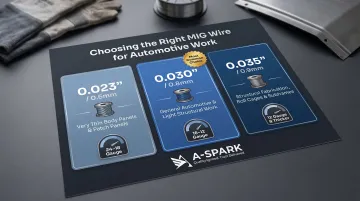
Confirm your machine supports 0.023"–0.030" wire for thin automotive sheet metal. Machines limited to 0.030" minimum may struggle with the finest body panel work.
Shielding Gas Compatibility
True MIG welding requires a shielding gas supply — typically a 75/25 Argon/CO2 mix, also called C25. "Flux-core only" machines marketed as "MIG welders" fall short for auto body work. Flux-core produces excess spatter and requires extensive post-weld grinding — adding time and risking damage to thin panels.
What to verify:
- Machine includes or supports a gas solenoid valve
- Compatible with dual-gauge regulator and gas hose
- Can run both gas-shielded solid wire (true MIG) and flux-core wire
Standard shielding gas for mild steel: 75% Argon / 25% CO2 (C25) produces clean, low-spatter welds with good arc stability and excellent penetration on automotive steel.
Best MIG Welders for Automotive Fabrication & Restoration
The machines below cover the full range — from hobbyist restoration tools to professional collision repair equipment. Each was selected based on:
- Amperage range and duty cycle for automotive work
- Automotive market reputation and user feedback
- Serviceability and parts availability
- Real-world performance on body panels and structural steel
Miller Millermatic 211 PRO
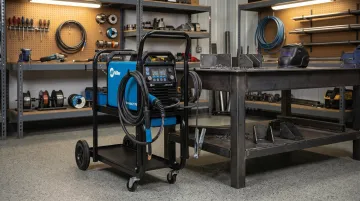
The Millermatic 211 PRO is Miller's dual-voltage workhorse built for professional auto shops and motorsports applications. Its Auto-Set™ technology automatically configures voltage and wire feed speed based on wire diameter and material thickness — ideal for shops moving between panel gauges throughout the day. That range covers both thin body panels and heavier structural fabrication, with steel capacity up to 3/8" and aluminum capability via an optional spool gun.
Key advantages:
- Dual 120V/240V input with MVP plug (works in garage or shop)
- 30–230A range covers everything from 24-gauge body panels to heavy structural steel
- 60% duty cycle at 110A (120V) and 60% at 160A (240V)
- Auto-Set eliminates guesswork for consistent welds across varying thicknesses
| Price Range | Key Specs | Best For |
|---|---|---|
| $1,550 MSRP | 30–230A; 120V/240V dual input; 60% @ 110A; Wire: 0.024"–0.035" | Professional fabrication shops, motorsports builds, chassis and body panel work |
Hobart Handler 140
The Hobart Handler 140 runs off standard 115V household current (20-amp circuit), requiring no electrical upgrades for home garage use. Hobart's parts availability is genuinely strong — combined with a complete out-of-the-box package (built-in gas valve, 10-foot MIG gun, dual-gauge regulator, ground clamp), this is one of the more complete setups at this price point for hobbyist restoration work.
Key advantages:
- 25A minimum for excellent control on thin body panels
- Welds 24-gauge up to 1/4" steel in single pass
- 20% duty cycle at 90A (adequate for typical restoration spot/tack welding)
- Complete out-of-the-box setup with gas equipment included
| Price Range | Key Specs | Best For |
|---|---|---|
| $500–$750 (street pricing) | 25–140A; 115V input; 20% @ 90A; Wire: 0.023"–0.035" | Hobbyist restorers, patch panels, rust repair, light structural work up to 1/4" |
Forney Easy Weld 140 MP
The Forney Easy Weld 140 MP packs MIG, flux-core, TIG, and Stick into one compact unit — useful for garage hobbyists who don't want to invest in separate machines. It handles shielding gas for clean MIG welds on sheet metal and manages up to 1/4" steel. Forney's US-based customer support is a genuine asset for beginners troubleshooting their first welds.
What to know:
- Multi-process flexibility (MIG, Flux-core, TIG, Stick) in one unit
- 30% duty cycle at 90A (MIG mode)
- Requires separate gas regulator and hose for MIG operation (not included)
- Lightweight (24.81 lb) and portable
| Price Range | Key Specs | Best For |
|---|---|---|
| $659.99 MSRP | 10–140A; 120V input; MIG/Flux/TIG/Stick; Wire: 0.030"/0.035" | Budget-conscious hobbyists, beginner restorers, multi-process flexibility |
How We Chose the Best MIG Welders for Automotive Work
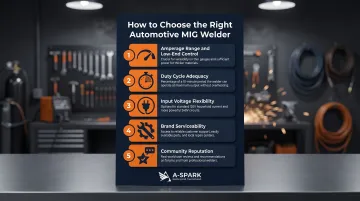
Our selection process prioritized five criteria tied to real automotive fabrication and restoration demands—not just impressive spec sheet numbers:
1. Amperage Range and Low-End Control
For thin sheet metal restoration, minimum amperage capability matters as much as maximum output. A machine that bottoms out at 50–60A will burn through 18-gauge body panels. Using 0.023" wire for 24–18 gauge panels requires a machine capable of 25–35A operation for proper heat control.
2. Duty Cycle Adequacy
Body work consists of short spot and tack welds, not continuous beads. A 20–30% duty cycle at 90A handles typical restoration sessions. Professional shops with continuous production demands should target 40–60% duty cycles to avoid frustrating cooling breaks.
3. Input Voltage Flexibility
Dual-voltage machines offer the most flexibility — garage hobbyists can move to a 240V shop environment without buying new equipment.
4. Brand Serviceability
Welders from established brands (Miller, Lincoln, Hobart) have nationwide service networks and stocked parts. Cheaper Chinese-branded units often perform adequately at first but become unrepairable within 5–10 years—a critical consideration for a long-term shop investment.
5. User and Professional Community Reputation
We consulted automotive fabrication forums, collision repair technician feedback, and motorsports builder recommendations to identify machines with proven track records in real-world automotive applications.
Conclusion
The best MIG welder for automotive work depends on your application depth and future plans. Hobbyist restorers working on weekend projects get excellent results from accessible 110V machines like the Hobart Handler 140 or Forney Easy Weld 140 MP, both of which handle body panel work and light structural fabrication without requiring electrical upgrades or breaking the budget.
Professional fabrication shops, collision repair centers, and motorsports builders should invest in machines with dual-voltage input, higher duty cycles, and advanced features like auto-set controls. The Miller Millermatic 211 PRO leads this category — handling everything from 24-gauge cosmetic panels to 3/8" structural steel with consistent, repeatable results.
One practical rule: buy one tier above your current needs. A machine that handles body panels today should also manage structural work tomorrow — and that headroom pays off in resale value, fewer frustrations, and room to grow as your projects get more ambitious.
For automotive and EV manufacturers that need precision-engineered metal components — die-cast aluminum housings, zinc structural brackets, or fabricated sub-assemblies — beyond what shop welding covers, A-SPARK Manufacturing provides end-to-end production support from IATF 16949-certified facilities in Vietnam.
Frequently Asked Questions
What is the best sheet metal for welding cars?
Low-carbon mild steel (typically 18–22 gauge) is the most commonly used and easiest-to-weld sheet metal for automotive body repair, offering excellent weldability, formability, and full compatibility with MIG welding. Galvanized steel also appears on OEM panels but requires grinding to remove the zinc coating before welding — the fumes are toxic and the residue contaminates the weld.
How much does custom sheet metal fabrication cost?
Custom automotive sheet metal fabrication costs vary widely based on complexity, material, and labor. Simple patch panels may run $50–$150, while full quarter panels or complex structural components can exceed $500–$2,000.
What two metals cannot be welded together?
Aluminum and steel cannot be directly MIG-welded together because they produce brittle intermetallic compounds that make the weld structurally unsound. In automotive work, aluminum body panels must not be MIG-welded directly to steel structural components without proper transition joining methods.
Is MMA stronger than MIG?
MMA (Manual Metal Arc/Stick welding) can produce strong welds on thicker structural steel but is not superior for automotive work. MIG produces cleaner, more precise welds on thin-gauge materials with significantly less spatter and cleanup — making it the go-to choice for automotive sheet metal.
What shielding gas should I use for MIG welding automotive sheet metal?
Use a 75% Argon / 25% CO2 mix (C25 or 75/25) for automotive MIG welding — it delivers clean, low-spatter welds on mild steel with stable arc performance. Pure CO2 is cheaper but produces more spatter; 100% Argon is reserved for aluminum welding with a spool gun.
What wire size is best for MIG welding thin automotive sheet metal?
Use 0.023" (0.6mm) wire for very thin body panels (20–24 gauge) as it provides finer arc control and reduces burn-through risk. 0.030" wire is a versatile choice for general automotive work covering both body panels and light structural components.